The collection

A sheet for the archive. A4 · print or save as PDF.

Minerals Silicates MC-0001
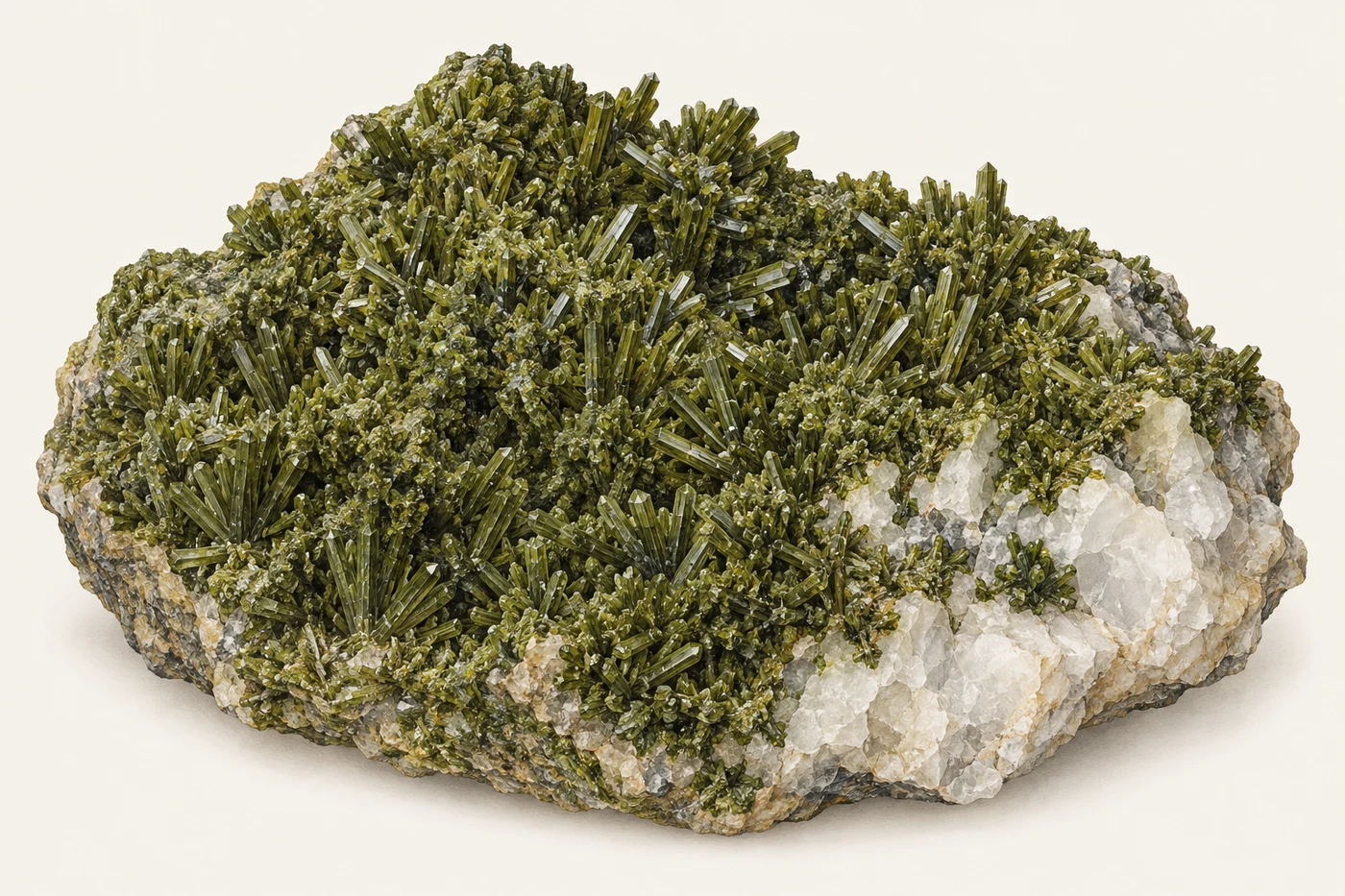
Illustrated reference of epidote on quartz; specimen photograph not yet added
5 × 3.5 in photographic plate
Illustrative study not a specimen photograph Photographic plate Epidote on quartz Şemdinli, Şemdinli District, Hakkâri Province, Turkey

Epidote is a calcium–aluminium–iron sorosilicate, Ca₂Fe³⁺Al₂(Si₂O₇)(SiO₄)O(OH), a monoclinic mineral whose structure is built from both isolated and paired silica groups. It is most familiar not as a mineral that grows in isolation but as a product of the chemical reworking of calcium-bearing rocks by metamorphic and hydrothermal fluids. On this specimen it coats quartz, the far simpler silica mineral SiO₂, in a dense olive-green to dark green layer over a pale quartz base, and that coating-and-substrate relationship is the specimen’s central story. The green colour, vitreous lustre, crystal form and quartz association are all consistent with epidote, though no analytical testing of this piece is recorded.

Epidote-quartz assemblages of this kind form where reactive, calcium- and iron-bearing rocks interact with circulating fluids — water moving through rock at depth or along fractures, carrying dissolved elements that precipitate as new minerals when conditions change. Where the fluid-rock system supplies calcium, aluminium and ferric iron, epidote can crystallize, while dissolved silica may separately come out of solution as quartz. This is a well-established general pathway for the pairing rather than a reconstruction of this specimen’s history; the exact process, temperature and sequence that produced it cannot be read from the minerals alone.

The epidote forms a crowded coating of small crystals, bladed to acicular — needle-like — and mixed with irregular radiating aggregates, individual crystals mostly only a few millimetres long. Rather than a flat druse, the coating is uneven and three-dimensional, built into ridges, tufts and shallow recesses that give the face a rugged, moss-like relief; it is this texture, thousands of tiny crystals read together, that earns the specimen its descriptive “Forest” name — a collector’s term for the appearance, not a species or variety. The dark olive-green colour follows from epidote’s chemistry, in which ferric iron in the structure contributes its characteristic yellowish- through brownish-green tones.

Beneath and between the green crystals the quartz substrate is exposed. Abundant epidote resting on quartz surfaces is consistent with sequential or overlapping growth — the quartz providing the substrate and open surfaces on which epidote later crystallized — though the exact order cannot be proved from appearance alone. The pairing is useful precisely because it sets two very different silicates side by side: hard, pale, silica-rich quartz against the darker, iron-bearing, more chemically complex epidote that coats it.

The recorded locality is Şemdinli, in far southeastern Turkey within the Zagros mountain belt, close to the borders with Iran and Iraq. Both epidote and quartz are independently documented there, and specimens from the locality show the same broad style of green epidote coating milky to clear quartz — support that is consistent with this piece without fixing it to any single mine, which the town-and-district label does not record. What the specimen shows most clearly is where the pale quartz emerges from beneath the crowded green coating: those exposed patches make the relationship between the two minerals legible, a compact example of epidote grown upon quartz.

Dimensions

≈ 12.0 × 9.0 × 4.0 cm

Length × width × height

Weight

533.9 g

Acquired

Not recorded

Source

Not recorded

Rockling Grove Personal collectionMC-0001

Beyond the specimen sheet

From the collection notebook.

Download original record

The complete observations, context, and open questions recorded for this specimen. These notes stay on screen; the sheet above is your printed copy.

Specimen profile 16 recorded details
Primary mineral
epidote
Associated mineral
quartz
Epidote formula
Ca2Fe³⁺Al2(Si2O7)(SiO4)O(OH)
Epidote group
Epidote Group, Epidote Supergroup
Epidote crystal system
monoclinic
Epidote hardness
Mohs 6
Epidote cleavage
perfect on {001}, imperfect on {100}
Epidote fracture
irregular/uneven
Epidote tenacity
brittle
Epidote luster
vitreous
Epidote typical colors
yellowish-green, green, brownish-green to black
Epidote specific gravity
approximately 3.38–3.49
Quartz formula
SiO2
Quartz crystal system
trigonal
Quartz hardness
Mohs 7
Quartz specific gravity
approximately 2.65–2.66
Specimen observations 11 notes

The display surface is overwhelmingly covered by dense olive-green to dark green epidote, producing a distinctly mossy or 'forest-like' appearance.

The epidote occurs as a crowded coating of small elongated, bladed to acicular-looking crystals and irregular radiating aggregates. Individual crystals are mostly only a few millimeters long.

Strong reflections from numerous small crystal faces give the otherwise dark green surface a conspicuous sparkle under direct illumination.

The epidote coating is uneven and three-dimensional, with ridges, tufts, shallow cavities, and darker recesses rather than a flat druse.

Milky-white to locally translucent quartz is exposed most prominently near one end/corner of the specimen and at the opposite margin. Much of the quartz substrate is concealed beneath epidote.

Some exposed quartz appears massive or broken rather than showing complete free-standing crystal terminations in the supplied photographs.

The specimen has a relatively broad, plate-like form with a low profile compared with its length and width.

The underside/edge exposes a pale tan to gray-brown matrix beneath the green crystalline surface.

The green color, vitreous reflections, crystal morphology, quartz association, and supplied label are all consistent with epidote, although the identification has not been analytically verified from this specimen.

Dimensions estimated from the centimeter grid and vertical ruler are approximately 12.0 × 9.0 × 4.0 cm. Irregular margins make these approximate maximum bounding dimensions.

Weight is directly shown on the digital scale as 533.9 g and is therefore treated as a measured value rather than a visual estimate.

Mineral profile 4 notes

Epidote is a calcium-aluminum-ferric iron sorosilicate with idealized formula Ca2Fe³⁺Al2(Si2O7)(SiO4)O(OH). It is a member of the epidote group and crystallizes in the monoclinic system.

The yellow-green through dark brownish-green coloration characteristic of epidote is related in part to ferric iron in its structure; the species ranges from transparent to opaque and commonly has a vitreous luster.

Epidote has Mohs hardness 6, perfect cleavage on {001}, imperfect cleavage on {100}, brittle tenacity, and measured specific gravity of about 3.38–3.49.

Quartz is SiO2, crystallizes in the trigonal system, has Mohs hardness 7, vitreous luster, and a specific gravity around 2.65–2.66.

Formation & geology 3 notes

Epidote is a widespread Ca-Fe silicate occurring in many geological settings and is especially familiar as a product of metamorphic and hydrothermal alteration of calcium-bearing rocks.

Epidote-quartz assemblages can form where reactive, calcium- and iron-bearing rocks interact with metamorphic or hydrothermal fluids. Silica may crystallize as quartz while epidote forms where the fluid-rock system supplies suitable calcium, aluminum and ferric iron.

The specimen's extensive epidote coating over quartz suggests sequential or overlapping mineral growth: quartz provided surfaces and open-space substrate on which abundant epidote subsequently crystallized. The photographs establish the physical relationship but do not by themselves establish the precise sequence or geological process.

Associated minerals 3 notes

Quartz is a documented associate of epidote specifically from Şemdinli. Mindat currently records both epidote and quartz for the town locality and lists quartz as the associated mineral in the epidote occurrence record.

Published collector specimens from the same locality show the same broad style of association: green epidote coating or growing on milky to clear quartz. One documented Şemdinli specimen is described as 'fuzzy green epidote on milky-white/clear quartz.'

The contrast is mineralogically and visually useful: pale silica-rich quartz forms the substrate while iron-bearing epidote supplies the dark olive-green crystalline coating.

Locality & provenance 4 notes

The supplied label gives Şemdinli, Şemdinli District, Hakkâri Province, Turkey. This geographic hierarchy is independently recognized by Mindat, which records Şemdinli as a town in Şemdinli District and specifically lists epidote and quartz there.

The Mindat epidote occurrence for Şemdinli is currently classified as 'believed valid,' with quartz recorded as an associated mineral. The occurrence reference is based on collector material and visual identification rather than a detailed published analytical study, so the locality is supported but should not be represented as analytically established for this individual specimen.

Şemdinli lies in far southeastern Turkey within the Zagros mountain/orogenic region, close to the borders with Iran and Iraq.

Collector material attributed to the wider Hakkâri area also commonly displays small green epidote crystals coating quartz, indicating that this association is represented by multiple specimens from the region.

Collection history 4 notes

An original-style dealer/locality label accompanies the specimen and reads: 'Forest' Epidote/Quartz; Şemdinli; Şemdinli District; Hakkâri Province; Turkey; Groundstar Minerals.

Groundstar Minerals branding on the label is retained as label evidence only; it does not establish that the current collector purchased the specimen directly from that dealer.

The descriptive trade/collector name 'Forest' is particularly apt for this specimen's dense dark-green, mossy crystalline surface, but it is not a mineral species or formal variety name.

A handwritten '195-' on the label may represent a former price, stock notation, or other dealer annotation. Its meaning cannot be established from the photographs and it is not incorporated as catalog or acquisition data.

Closer looking 5 notes

The strongest visual story is the specimen's 'forest' texture: thousands of small olive-green epidote crystals collectively transform pale quartz into a rugged, moss-like miniature landscape.

The specimen illustrates mineral succession especially clearly where exposed pale quartz emerges from beneath the dense epidote coating.

The contrast between quartz and epidote links two very different silicate structures and physical appearances in one specimen: hard, pale silica alongside darker calcium-iron-aluminum epidote.

The locality has unusually direct supporting evidence for this exact mineral pairing: both epidote and quartz are specifically recorded from Şemdinli, and photographed collector specimens from the locality show comparable green epidote-on-quartz material.

At more than half a kilogram and roughly 12 cm across, the piece has enough surface area for the aggregate texture—rather than a single dominant crystal—to be its principal display feature.

Open questions & uncertainties 6 notes

Epidote and quartz identification is strongly supported by the accompanying label, visible appearance, and independent records of the same association from Şemdinli, but no analytical testing of this individual specimen is supplied.

The locality should remain at the town/district level given on the label. No specific mine, quarry, vein, or collecting site is provided, and none should be inferred.

Dimensions are image-derived estimates. Length and width are relatively well constrained by the centimeter grid; height is less precise because of irregular topography and photographic perspective.

The 533.9 g weight is clearly visible on the scale display and is substantially more reliable than the estimated dimensions.

The exact nature and growth sequence of the pale quartz and green epidote cannot be proved from photographs alone.

The handwritten '195-' on the dealer label is uninterpreted and deliberately excluded from acquisition history.

Acquisition & collection history Provenance
Collection ID
MC-0001
Acquisition date
Not recorded
Acquisition place
Not recorded
Vendor
Not recorded
Previous collection
Not recorded
Previous collection number
Not recorded

Accompanying Groundstar Minerals label identifies the specimen as 'Forest' Epidote/Quartz from Şemdinli, Şemdinli District, Hakkâri Province, Turkey. A handwritten '195-' appears on the label; its meaning is unknown and is not treated as acquisition or provenance information.

Words in this record 10 short explanations
Acicular
Needle-like: long, slender crystals. Open University
Cleavage
A mineral's tendency to split along particular flat planes in its crystal structure. Mineralogical Society of America
Crystal system
A category of internal crystal symmetry. It may differ from the specimen's outward shape. Open University
Hydrothermal
Processes involving hot water moving through rock, carrying dissolved material and sometimes depositing minerals. USGS
Lustre
How a mineral's surface reflects light, such as glassy, metallic, pearly, or dull. Mineralogical Society of America
Massive
A solid aggregate in which individual crystal shapes are not clearly visible. Open University
Mohs hardness
Resistance to scratching, ranked from 1 to 10. A harder mineral can still break easily. Mineralogical Society of America
Specific gravity
Density compared with water. Higher values mean more mass in the same volume. Mineralogical Society of America
Tenacity
How a mineral responds to bending, breaking, or cutting; brittle minerals break rather than bend. Mineralogical Society of America
Vitreous
A glass-like surface sheen. Mineralogical Society of America